
Through the Academic Model Providing Access to Healthcare (AMPATH) Ghana, Temple faculty and students work closely with students, pharmacists and healthcare educators in Ghana to address gaps between classroom learning and clinical practice.
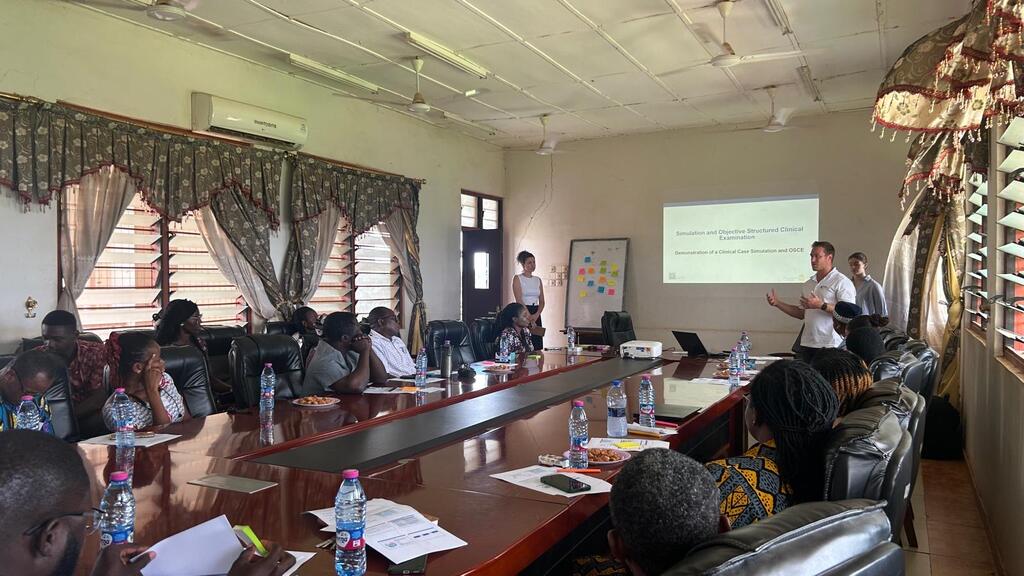
Through the Academic Model Providing Access to Healthcare (AMPATH) Ghana, faculty and students from Temple’s Lewis Katz School of Medicine and the School of Pharmacy work with healthcare educators in …
The summer after Gabrielle Stuart’s first year as a student at Temple’s School of Pharmacy looked different from many of her classmates.
While her peers completed traditional internships, Stuart, now in her second year, found herself in Tamale, Ghana, collaborating with students from the Temple Emergency Action Corps at the Lewis Katz School of Medicine as well as the University for Development Studies (UDS) School of Pharmacy and Pharmaceutical Sciences and Tamale Teaching Hospital in Ghana. Through a program called the Academic Model Providing Access to Healthcare (AMPATH) Ghana, the group collaborated and co-designed a pharmacy training program that addresses gaps between classroom learning and clinical practice.
Stuart and Katz students Anastasia Velikovskaya and Austin Patrick Malloy joined three Ghanaian pharmacy students from UDS in Tamale to develop a hands-on curriculum that uses patient-actors for pharmacy education training.
“We weren’t there to teach pharmacy content; this was really about education systems, health policy and best practices,” said Malloy. “We asked, ‘What works here? What’s realistic here?’ and built from that.”
Their study, “In situ simulation in pharmacy education to improve pharmacists’ patient care process,” demonstrated the curriculum’s success. Specifically, more than 90% of students perceived the training program as relevant to their education and future pharmacy practice, more than 80% reported feeling more competent in medication management skills, and more than 80% felt that they gained confidence in applying their pharmacotherapy skills and communication.
“Equitable global health research requires a context-driven and collaborative approach for bi-directional learning and long-term sustainability,” said Tina Tran, assistant professor of pharmacy practice. “The participatory nature of our research fostered ownership, built consensus, and ensured relevance to both local realities and global standards.”
AMPATH Ghana is a partnership between U.S. and Ghanian academic medical institutions and others to ensure sustainable healthcare for all in northern Ghana.
A defining feature of the program is its interdisciplinary approach. During the summer experience in Ghana, Tran served as the faculty lead for the student cohort, guiding the collaborative research and education work focused on simulation-based pharmacy training. Her leadership ensured that the project reflected both global health best practices and the realities of pharmacy education and clinical care in northern Ghana.
“Having faculty leadership from the School of Pharmacy was essential,” said Zoe Maher, associate professor of surgery at Katz and surgical lead for AMPATH Ghana. “Dr. Tran brings deep experience in AMPATH and a strong commitment to global health equity. Her role exemplifies how this partnership brings together expertise across Temple to support meaningful, sustainable collaboration.”
For the Katz students, the experience reshaped how they think about global health—and their future roles as physicians.
“Working side by side with Ghanaian students and faculty was incredibly eye-opening,” said Velikovskaya. “They were the experts in their environment. Our role was to listen, learn and collaborate. That mindset completely changes how you approach global health work. And collaborating with pharmacy students and faculty broadened how I think about healthcare teams. It reinforced that improving patient care often starts with improving how we educate and support health professionals.”
In June 2024, Temple joined the AMPATH Consortium, an international network of health centers dedicated to advancing health equity through long-term, locally grounded collaborations. Through this consortium, Temple has partnerships in Kenya, Mexico and Nepal as well. Temple’s initial participation is focused on surgery and pharmacy in Ghana and Kenya.
That same year, the first cohort of Katz medical students traveled to the Tamale Teaching Hospital for research and clinical experiences, while sixth-year medical students at UDS, Abdul-Razaq Seidu and Wisdom Anabzua, from Ghana were hosted by Maher and Temple Health for clinical observations.
“Programs like AMPATH Ghana exemplify how we educate physician leaders at Katz,” said Amy J. Goldberg, the Marjorie Joy Katz Dean of the Lewis Katz School of Medicine. “Our students are learning that meaningful global health work is rooted in partnership, humility and long-term commitment—not short-term service. These experiences shape how they will practice medicine, advocate for patients and lead within complex health systems."
“Pharmacy education at its best prepares students not just for the patients in front of them, but for the complex, interconnected world they’ll practice in. Real, lived experiences with colleagues from across the globe like this opportunity with AMPATH Ghana do exactly that,” added S. Suresh Madhavan, dean of the School of Pharmacy. “By immersing our students in a different setting and challenging them to listen, adapt and collaborate, we’re expanding the boundaries of what a pharmacy education at Temple can be. Experiences like this don’t just supplement our curriculum; they strengthen it.”
As the program continues to grow, Katz will expand summer research opportunities, fourth-year clinical electives in Ghana and hosting of Ghanaian trainees in Philadelphia—ensuring the partnership remains dynamic, reciprocal and deeply connected to community needs.
Additionally, Tran received a Research Project grant from the National Heart, Lung and Blood Institute of the National Institutes of Health to build global capacity for clinical pharmacy and implement science training in HIV and cardiovascular disease management. She will also continue to train Temple students through a research project to assess barriers and facilitators to availability of essential medications for cardiovascular disease in northern Ghana this summer.
The impact of AMPATH is already clear for students like Malloy, Velikovskaya and Stuart, as well as Ghanian student trainees like Seidu and Anabzua.
“This experience showed me that collaboration and equity aren’t abstract ideas. They’re daily practices. And that’s something I’ll carry with me throughout my career,” said Velikovskaya.
“I’m going to be a better pharmacist because of this program,” added Stuart. “I’ll be able to support my patients in a better way.”