
Philadelphia seventh graders received their white coats at a ceremony marking the launch of Temple’s Lang Medical Scholars Program. The six-year program introduces Philadelphia students to medicine, science and the many career pathways available across healthcare.

Thirty-two Philadelphia seventh graders received their white coats at a ceremony at the Lewis Katz School of Medicine on Sept. 19.
Photo by Lester Hinton
Melvin Poulson IV, a seventh grader from North Philadelphia who attends Hope Partnership School, has been interested in pursuing a career in medicine since he was in pre-K.
“I remember he asked me how to spell esophagus when he was little,” said his mother, Allison Agee.
For Poulson and 31 other Philadelphia seventh graders aspiring to go into healthcare, they are already dressing the part.
On Saturday, Sept. 19, the seventh graders received their white coats at a special ceremony marking the launch of Temple’s Lang Medical Scholars Program. The free, six-year program introduces Philadelphia students to medicine, science and the many career pathways available across healthcare in the same medical education facilities Temple medical students use.
“It was a long-awaited process, and I’m so proud of him. It’s a blessing these students have an opportunity like this,” added Agee.
Temple’s Lang Scholars Program is the brainchild of Barbara Klock, a pediatrician and educator who also served as the chief medical health officer for the School District of Philadelphia during the COVID-19 pandemic.
“I’m very excited about bringing students from all different schools together from all different parts of the city to Temple, to learn together about themselves; how the body works; and how they can provide care for themselves, their families and their communities,” said Klock.
Beginning in seventh grade, Lang Medical Scholars take part in twice-a-month interactive Saturday sessions at the Katz School, engaging in hands-on learning focused on the human body while interacting with physicians, nurses, scientists, researchers and other healthcare professionals. The longitudinal program also provides students with opportunities for summer internships, leadership development, SAT preparation and college application support as they progress through high school. Sessions for the inaugural cohort began on Oct. 3.
Funded by philanthropy and grants, Klock began laying the groundwork for the program in 2024. She traveled school by school throughout the city speaking to sixth-grade classes and inviting students to apply. The program was initially designed for 20 students, but Klock was stunned when 272 students applied.
“The outpouring of applications was remarkable,” she said. “I couldn’t take just 20.”
Klock approached Amy J. Goldberg, the Marjorie Joy Katz Dean of the Katz School of Medicine, and received permission to expand the program to 32. Each year, a new cohort of approximately 30 seventh graders will join the Lang Scholars, expanding the program to 180 once grades seven through 12 are filled.
Applicants had to answer open-ended questions and submit teacher recommendations. Selected students were then invited to participate in an interview. Klock notes she did not want to choose students based on teacher and guidance counselor recommendations alone.
“I wanted to be open to the kid in the back of the classroom,” she said. “The kid who is curious about science but maybe reserved and needed some encouragement.”
Klock was also intentional about bringing together students from across the city. Eighty-one percent of the cohort comes from School District of Philadelphia schools, with students representing 24 schools across the city, including 18 within the district.
“While Philadelphia is a city of neighborhoods, I feel it can also be a city of islands,” she said. “We have students who live around the corner from Temple and students from South Philly. The goal was really to bring together students from all over the city who might not ordinarily have opportunities to meet each other.”

Program Director Barbara Klock with Melvin Poulson IV and his mom, Allison Agee. Agee attended the ceremony wearing a custom “Lang Scholars Mom” shirt that her sister made.
Photo by Lester Hinton
Making an entrance
Temple’s mascot Hooter gave out high-fives before the seventh graders processed into the auditorium at the Lewis Katz School of Medicine to Katy Perry’s “Roar.”
Temple President John Fry then welcomed the students and their families.
“Please do not underestimate the significance of this occasion,” said Fry. “The future of Philadelphia depends on developing a healthcare workforce that reflects, understands and is deeply committed to the communities its serves. We carry the proud distinction of being Philadelphia’s public research university, and we have always worked diligently so that all high-performing students, especially those from right here in Philadelphia, have access to the excellent education that is the hallmark of Temple University. Your presence here today tells me that each of you has a bright future ahead of you. It is my hope that you will continue to cultivate a love of learning and knowledge.”
Dean Goldberg emphasized that a career in healthcare begins with curiosity.
“You are at the very beginning of your journey,” she said. “You have a lot to learn, but you also have something incredibly valuable already. Your curiosity. Hold onto it. Let it guide you. Take everything in. Ask questions. The questions that seem obvious, and the questions that seem impossible. And when something captures your interest, follow it. You never know where curiosity will take you.”
A white coat ceremony is a symbolic rite of passage marking a student’s entrance into medical school or other health professional training. Before students were called up individually to receive their white coats from President Fry and Dean Goldberg, the dean explained the significance of the ceremony.
“Today, you will be given a white coat, and I want you to understand what that means,” she said. “A white coat is a symbol of medicine. It represents knowledge, compassion, service and the responsibility that comes with caring for another person. But today, your white coat represents something else, too. It represents possibility, because for each of you, this is just the beginning. The beginning of launching your curiosity wherever you want to take it, for the good of the world around you.”
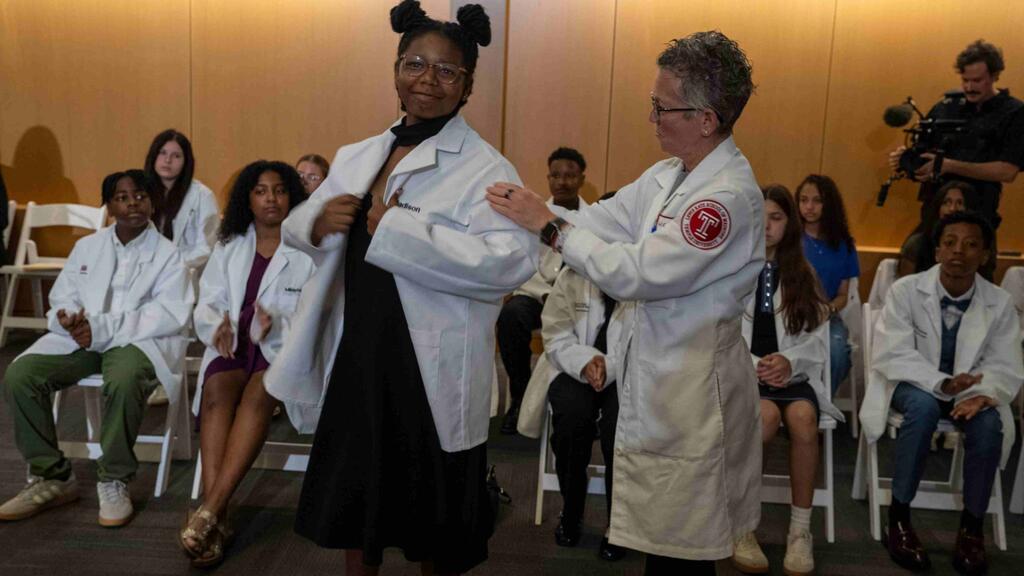
Madison Miller receives her white coat from Dean Goldberg during the Lang Medical Scholars White Coat Ceremony.
Photo by Lester Hinton
Honoring a mentor
Klock named the program after her long-time mentor, Eugene M. Lang. Lang is best known as a businessperson and philanthropist who created the I Have a Dream Foundation.
Klock knew Lang through Swarthmore College, where she attended college and received a scholarship through its Lang Scholars Program. They kept in touch over the years and ran into each other at Philadelphia’s 30th Street Station in the 1990s. During that serendipitous meeting, Lang shared his vision for a youth medical program.
“He was going for a board meeting at Swarthmore, and he said, ‘You know, Barbara, I have this new vision, and it’s for kids who are interested in science and healthcare.’”
The idea stuck with Klock. A similar program exists at Columbia University Medical School NewYork-Presbyterian Hospital, which Klock followed for years and served as the inspiration to bring Lang’s idea to fruition in Philadelphia.
“I went to New York several times to see it in practice, I even covered for someone to teach a session,” she said. “I’ve always dreamed about bringing this program to Philadelphia students. The program is called the Lang Medical Scholars Program because anything that has the ‘Lang’ name on it represents social justice and community service.”
A Philadelphia native, Klock was a practicing pediatrician at the Children’s Hospital of Philadelphia for more than 20 years before serving as chief medical health officer for the School District of Philadelphia. She continues to work with the School District of Philadelphia teaching the certified school nurse induction program, a Pennsylvania-required professional development program that helps school nurses reach their next level of certification. With her deep knowledge of the city, she says Temple was a natural choice to house the Lang Medical Scholars Program.
“I knew that I wanted it to be Temple because of where Temple is located and Temple’s mission,” she said. “To me, Temple means Philadelphia, and Temple’s support of Philadelphia students and vision for the community makes this a great partnership.”
Klock is keenly aware that all the students may not pursue medical school in the future, but she is confident they will be prepared to live compassionate lives.
“By bringing these students from different neighborhoods together, they will develop cultural humility and appreciation of others that is needed for any career and especially healthcare,” she said. “My vision is to help them discover who they are and what kind of person they want to be and how they can help others.”
Klock is eager to see the program grow. Recruitment for next year’s cohort is already underway.
“The students are looking for this,” she said. “The parents are eager for their children to participate. The spark is out there. We need to reach these kids.”
Poulson is looking forward to attending the Saturday sessions.
“I’m excited I get a chance to attend the program and learn more about the human body,” he said. “I’ve always liked science, and I’m excited to learn about helping patients.”