
At The Lewis Katz School of Medicine’s seventh annual Future Physician Research Symposium, students presented projects spanning clinical medicine, public health, health equity, technology and surgical care. Together, the presentations reflected their commitment to asking questions that can ultimately make a difference for patients.
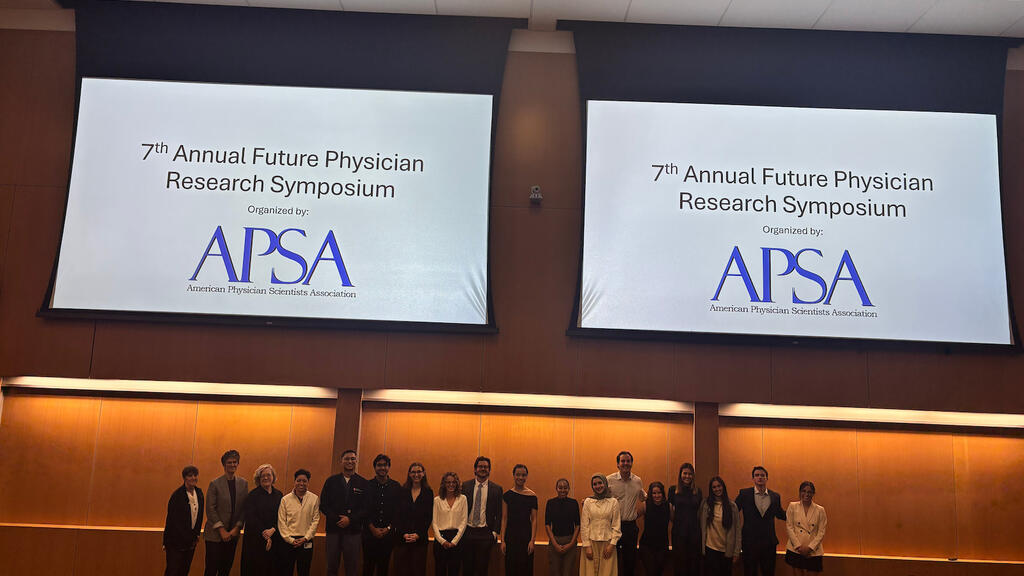
Established by Amanda Peluzzo, an MD/PhD student in her eighth year of study, and sponsored by the Temple University Chapter of the American Physician Scientist Association (APSA), the symposium is more than just a series of presentations. “I founded the Symposium seven years ago to give students experience in abstract writing, presenting, and answering questions, but it’s also a great way to network with younger students about research opportunities,” said Peluzzo.
Together, Tim Hanlon, APSA President and fourth-year MD/PhD student, and Emily Noonan, APSA Vice President and fourth-year MD/PhD student, organized the event. For Noonan, “the Symposium is a celebration of students’ dedication to advancing the health of our local and global communities.”
This year’s presentations highlighted how research can translate into practical improvements in care. One project explored the use of artificial intelligence to automatically measure brain fluid volumes in children to assist in diagnosing hydrocephalus, while another tested a simple “Step-Up Test” to help determine when patients recovering from leg surgery are ready to safely return to driving.
Other projects centered on questions that extend beyond a single procedure or diagnosis. Students investigated whether commonly prescribed GLP-1 medications may reduce the risk of stroke and death in patients with narrowed carotid arteries, as well as early outcomes in breast reconstruction with newly available large-volume implants. In another study, students explored pain and opioid use following gender-affirming surgery.
Students’ research also examined the broader circumstances that influence health. One project examined postpartum anemia screening across racial and ethnic groups, psychiatric emergencies among patients with COPD, and the ethical challenges of treating patients who refuse care in the setting of complex psychiatric and medical conditions. Another project explored how family, neighborhood environment and lived experience shape the work of credible messengers in a Philadelphia community violence intervention program.
“A lot of what students presented applied directly to patients in North Philadelphia and the surrounding area. This really speaks to how students, researchers and clinicians care not only for patients now but also for the future of patient care,” said Hanlon. One such study evaluated a classification system designed to help clinicians identify and manage wounds associated with xylazine, an increasingly common contaminant in the illicit drug supply.
“The Symposium shows Katz’s culture of curiosity and perseverance through longitudinal research projects, leading to discoveries that can impact patient care in meaningful ways,” remarked Peluzzo.